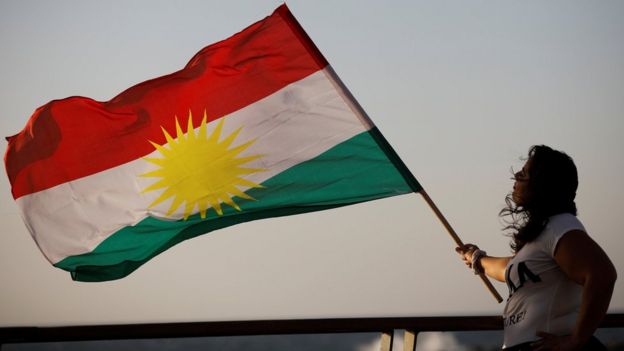
Woman holding Kurdish flag.
Background
Who are the Kurds?
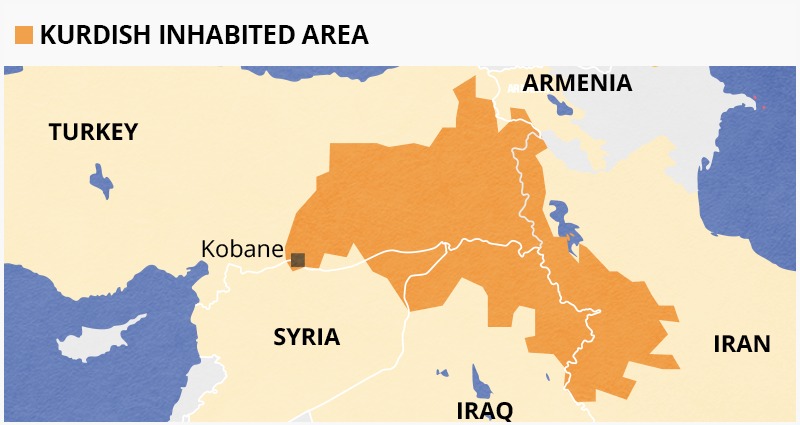
The Kurds are one of the indigenous peoples of the Mesopotamian plains and the highlands in what are now south-eastern Turkey, north-eastern Syria, northern Iraq, north-western Iran and south-western Armenia. Today, they form a distinctive community, united through race, culture and language, even though they have no standard dialect. They also adhere to a number of different religions and creeds, although the majority are Sunni Muslims. They are considered the largest ethnic group in the world to be stateless. In the early 20th Century, many Kurds began to consider the creation of a homeland – generally referred to as “Kurdistan”. After World War One and the defeat of the Ottoman Empire, the victorious Western allies made provision for a Kurdish state in the 1920 Treaty of Sevres. Such hopes were dashed three years later, however, when the Treaty of Lausanne, which set the boundaries of modern Turkey, made no provision for a Kurdish state and left Kurds with minority status in their respective countries.
Over the next 80 years, any move by Kurds to set up an independent state was brutally quashed. After the first Gulf War, followed by a Kurdish uprising in northern Iraq and the establishment of a no-fly zone, the Kurds managed to establish a semi autonomous region. In 1992, an alliance of political parties, the Iraqi Kurdistan Front, held parliamentary and presidential elections. As a result, the Iraqi Kurdistan Front established the Kurdistan Regional Government (KRG), a new autonomous Government of Kurdistan in Iraq.The KRG is a secular government modeled along the lines of modern independent nation-state in a federation with the rest of Iraq. They have their own parliament, military (the “Peshmerga”), borders and foreign policy. In 1994, a power-sharing arrangement between the Patriotic Union of Kurdistan (PUK) and the Kurdistan Democratic Party (KDP) collapsed. This decay lead to civil war and two separate administrations.
Connection
To Turkey
The group has fought for three decades for greater autonomy for the Kurdish ethnic group in Turkey and an end to repressive government policies. Kurds have had a long history of discrimination perpetrated against them by the Turkish government. Massacres have periodically occurred against the Kurds since the establishment of the Republic of Turkey. Many people who spoke in the Kurdish where being arrested and imprisoned. Many of their villages where set to fire and destroyed. The Kurds have where suffering from execution, torture and forced displacement, and today they risk their survival of their ethnicity due to the betrayal of the U.S ally in the fight against the Islamic state, as turkey launched an offensive again the Kurdish forces.
To Syria
Assad supported Kurdish rebels in Northern Iraq as they fought Iraqi forces. In 1975, the Patriotic Union of Kurdistan was established in Damascus by Jalal Talabani and the Syrian regime established formal ties with Kurdistan Democratic Party in 1979.
References
Kingsley, Patrick. “Who Are the Kurds, and Why Is Turkey Attacking Them in Syria?” The New York Times. The New York Times, October 14, 2019. https://www.nytimes.com/2019/10/14/world/middleeast/the-kurds-facts-history.html.
Siobhán O’Grady, Miriam Berger. “Who Are the Kurds, and Why Is Turkey Attacking Them?” The Washington Post. WP Company, October 23, 2019. https://www.washingtonpost.com/world/2019/10/11/who-are-kurds-why-is-turkey-attacking-them/.
“Who Are the Kurds?” BBC News. BBC, October 15, 2019. https://www.bbc.com/news/world-middle-east-29702440.
“Who Are the Kurds?” Voice of America. Accessed December 5, 2019. https://www.voanews.com/middle-east/who-are-kurds-0.
 Watch Turkey